Ethnographic Materials
This section gathers the ethnographic materials produced through my research process. It includes online observations of reviews and discussions on RED, photographs from on-site visits to a London Haidilao restaurant, and audio excerpts from conversations with three participants.
💪🏋️
Fitness-oriented diner
Negative evaluations do not affect his dining decision. He mainly browses related content online but does not participate in commenting, nor does such content alter his consumption behaviour. His visit to Haidilao is driven by a clear purpose: to consume meat and protein. This fixed consumption goal stabilises both his attention allocation and actual dining practice. In this context, evaluative content functions only as background information rather than as a basis for decision-making.
🎓🏫
Budget-sensitive student
In contrast, negative evaluations operate as points of stimulation rather than rejection. He wants to verify personally whether the criticism is accurate. Motivated by the desire to “get his money’s worth,” negative evaluations become a trigger for action rather than a reason to withdraw. The reviews do not prevent consumption, but reshape expectations and modes of judgement.
👟🗺️
Tourist participant
She enters Haidilao in search of emotional and cultural connection to China, but the actual experience produces disappointment. This disappointment does not translate into repeat consumption. Instead, it is converted into online expression. She is more likely to publish negative evaluations, transforming personal experience into platform content.
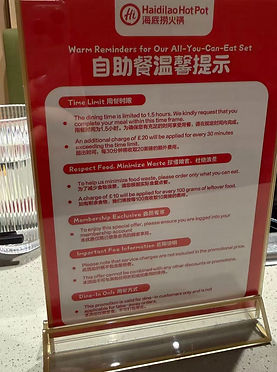
Image Description
This photograph was taken in the self-service dining area of a Haidilao restaurant in London. A red notice board on the table lists regulations including time limits, overtime charges, leftover penalties, membership requirements, and dine-in restrictions.
Image Description
The condiment station is neatly arranged, yet no customers are present. In contrast to the crowded scenes of peak dining hours, this moment appears unusually quiet.


Image Description
This photograph was taken on 4 October 2024, when the Haidilao restaurant was still crowded with customers. The image shows the waiting area, where diners sit closely together while waiting to be seated.
Image Description
The interior dining area of a Haidilao restaurant appears during what is usually considered peak hours. Rows of booths line the corridor, yet most seats remain unoccupied. The central walkway is clear, with only one staff member visible in the distance. Screens continue to display menu and promotional content, and the tables are fully prepared for service. The space conveys readiness for a large number of diners, while their presence is largely absent.


Image Description
A printed promotional menu for an all-you-can-eat hot pot set lies on a dining table inside a Haidilao restaurant. The starting price is highlighted in large red text, with different time slots listed alongside their corresponding prices. Photographs of meat, seafood, vegetables, and side dishes are arranged in a grid layout across the page.
Image Description
The screen shows an all-you-can-eat hot pot set priced at £29.99, accompanied by a countdown timer and an “Add now” button. Time, price, and food images are presented together on a single interface.
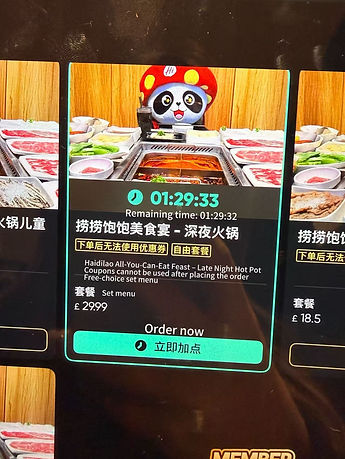

Image Description
The image records a table of food from a Haidilao all-you-can-eat meal, photographed during dining inside the restaurant. A four-section hot pot occupies the centre, with various ingredients and sauces arranged around it in uniform white square dishes.


