Findings: From Crisis to Value
Negative evaluations are not simply points of consumption failure. Rather, they function as starting points that trigger different pathways, through which moments of crisis are converted into visibility, interaction, and value.
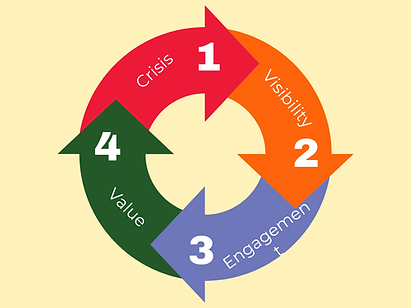
Conceptual diagram developed by the author based on ethnographic analysis.
The stabilisation of consumption and the generation of steady traffic are not grounded in trust or distrust toward evaluative content, but in the presence of fixed consumption goals. For this group of users, dining decisions are not driven by the pursuit of experience or comparison, but by the fulfilment of specific needs, such as protein intake, eating efficiency, and certainty in portion size relative to price. Under these conditions, the positive or negative orientation of evaluations does not function as a primary reference point. This constitutes a form of downgraded evaluation, in which attention and consumption behaviour are already stabilised. Within this configuration, economic value is maintained through the parallel operation of goal-oriented consumption and platform traffic logics. Crucially, negative evaluations do not produce loss here. Instead, supported by fixed demand, they coexist with the production of profit.
For other participants, particularly those with high budget sensitivity, negative evaluations operate differently. Budget sensitivity shapes this group of consumers’ desire to consume. The presence of negative reviews generated curiosity and scepticism, motivating an in-person visit to “see whether it was really like that.” This form of engagement transforms critique into momentum. Rather than interrupting circulation, negative evaluations here intensify it by producing action. Consumption is not cancelled but recalibrated: expectations are lowered, price sensitivity increases, and value is redefined around “getting one’s money’s worth.” In this sense, negative reviews do not exit the economic loop but re-enter it as a mechanism that sustains both attention and footfall.Here, algorithmic visibility does not simply persuade users but activates them, turning doubt and comparison into forms of participatory labour within platform capitalism.
In a different configuration, this response shows how disappointment and the experience of temporal loss generate expressive content, making negative experience more likely to be articulated and shared. In other parts of the material, value is sustained through continued consumption or curiosity-driven engagement. Here, however, value is produced through content itself, as frustration is translated into posts, warnings, and comparative narratives.